.png)



Most finance transformation aims at speed. Tighter close calendars, better extracts, more automation wrapped around the reconciliation. But faster reconciliation is still reconciliation. In September we brought a room of CFOs and finance leaders together in Kuala Lumpur to show what changes when AI sits inside a governed data foundation rather than next to it, and what it removes at each step of the finance cycle. This is what we walked through.
The problem every CFO recognises
Every CFO has had the meeting where the number itself is questioned. Someone has a different figure, and forty minutes disappear into whose export is right.
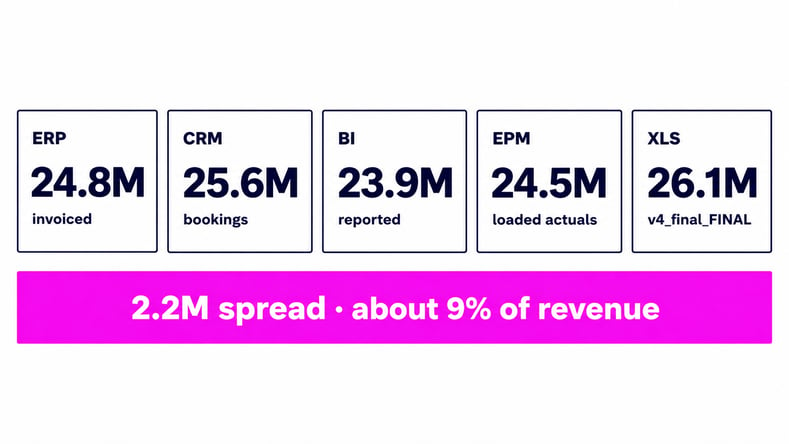
It is structurally guaranteed. Ask five systems what revenue was last month and you get five defensible answers. The ERP counts what was invoiced, the CRM counts bookings, BI applies exclusions and business rules, EPM loaded actuals a week ago, and the spreadsheet that went into the pack says something else again. In the scenario we built to illustrate it, the gap came to roughly 9% of revenue. Run it against your own last close and see where you land.
None of those systems is wrong. Each answers a slightly different question, correctly. But the company reports one number, on time, and it has to be right. Finance is what stands between five versions and one signed one, and nobody else in the business is doing that job.
That guarantee is where the month goes: reconciling versions, chasing extracts, and turning every "why" into a ticket. Which is why the instinct is always to make that work faster.
The opportunity is removal, not speed. And removal only becomes possible when one thing is true underneath.
Why finance AI pilots stall without a governed foundation
There is a reason most AI conversations in finance stall at the pilot. AI gets put next to the data rather than inside it. It reads from the same five systems that already disagree and produces a sixth answer, with more confidence and less traceability than any of the others. It demos well. It cannot be signed.
Finance will not put its name to a number it cannot trace. That is not conservatism, it is the job. So the foundation is not the boring part to get through before the interesting part. It is the difference between a tool finance uses and a tool finance politely stops opening.
What it means is narrow and concrete. Entity, account, period and currency conformed once in the model rather than re-derived in every report. FX translation and intercompany elimination handled in the foundation rather than in a workbook only one person can read. And above all, definitions governed centrally: one meaning per measure, encoded once, used everywhere.
That last point is what ends the meeting described at the top of this piece. Gross margin stops being something each team implements in its own dashboard and becomes something the business holds one definition of. Finance, sales and operations arrive with the same figure because they read from the same model, not because someone reconciled them beforehand. Reconciliation does not get faster. It stops having a reason to exist.
The assumption worth retiring is that getting there is a multi-year programme. It was, when the only route was pipelines, semantic layers and a build measured in quarters. It is a known exercise now, across ERP, consolidation tools, subledgers, payroll, CRM and entity workbooks.
Once it is true, AI stops being a general purpose assistant with an opinion about your business and becomes something narrower and far more useful: a set of defined tasks that run at each step of the month.
There are four of them, and they follow the month in order.
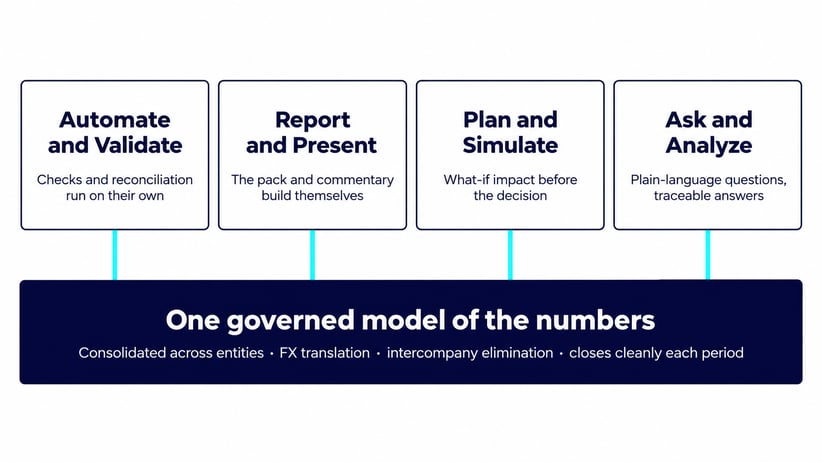
1. AI in the financial close: Automate and Validate
Today. The close is a hunt. Analysts chase what is missing rather than explaining what changed. Completeness is verified by someone scrolling. Anomalies are found when a number looks wrong to a human who happens to know what right looks like, which means they are found by the two or three people who have been there longest.
What changes. Completeness checks run automatically every period. Reconciliation runs with alerts, so exceptions surface instead of slipping through silently. Anomalies and data quality issues are detected without manual hunting.
The design principle matters more than the feature list: only genuine exceptions come back to a human. The system is not producing a longer list for finance to work through. It is producing a much shorter one, with everything it could resolve already resolved.
Once the period is validated and closed, the insight generation for performance review is triggered automatically, which is where the second step begins.
2. AI-generated financial reporting: Report and Present
Today. The pack is assembled by hand. Numbers are pulled, benchmarked against budget and prior year in a workbook, pasted into slides, and the commentary is written from memory and scattered notes, because the system holding the numbers does not hold the reasons.
What changes. Validated numbers are benchmarked against budget and prior year automatically. The narrative explaining what moved and why is generated by Snowflake Cortex AI from the numbers themselves, in plain language. And the output is an editable deck, not a locked dashboard and not a data dump.
That distinction is deliberate and it is the one finance teams react to most. A dashboard is something you navigate. A deck is something you take into a meeting, edit, disagree with, add your judgement to and present. The same governed numbers also power a live dashboard for anyone who wants to go deeper, but the deliverable finance actually needs on close day is the pack.
Worth being precise about the quality of that commentary. A real generated review does not only state that EBITDA beat budget. It flags that a large part of the beat came from other income and capital-funding entities included at region scope, that the resulting margin is inflated and does not represent underlying trading, and that one entity showing zero revenue against a material budget is worth confirming as a posting or timing item.
3. AI scenario planning and what-if analysis: Plan and Simulate
Today. The CEO asks what happens if you push price on two product lines. You wait for the close, find someone who can build the model, agree assumptions in a meeting, then check the output because the first version never ties out. By the time it lands, the commercial team has already committed, because they could not wait either.
What changes. What-if scenarios run against the same governed model as the actuals. You change an assumption and see the impact immediately, driver by driver, on the consolidated P&L. Different versions can be compared side by side rather than existing as competing files.
Two things make this trustworthy rather than merely fast. The scenario reads from the same foundation the actuals came from, so there is no reconciliation step between the plan and the reality it is planned against. And the assumptions are yours, stated explicitly, not inferred by a model.
One honest scope note, because it matters for evaluation: this is impact analysis, not a full planning suite. It answers what a decision does to the consolidated P&L before it is taken. It does not replace your budget process.
4. Natural language financial analysis: Ask and Analyze
Today. Every "why" is a ticket. The question goes to someone who can write the query, joins a queue, comes back as an extract, and becomes another spreadsheet that immediately begins diverging from the source.
What changes. Questions are asked in plain language and answered from governed data through Cortex AI, running inside the same security boundary as the numbers it reads. No SQL, no ticket, no wait. Revenue by business unit and department, then the drivers underneath it, in the same conversation.
Two things are worth pulling out. Answers are consistent and traceable, because the semantic layer is encoded once and centrally, so the same question asked twice returns the same answer and you can follow it back to the source. That consistency is what makes it usable in front of a board.
And external context is brought in rather than left out. Economic signals, market data and geopolitical factors sit next to the internal numbers they affect, so a revenue movement can be read against a tariff change or a regulatory shift without someone going away to research it separately.
An accelerator, not an off-the-shelf product
Off-the-shelf SaaS is fast, but your model bends to theirs, your data leaves your environment, and licences stack up. A bespoke build is yours, but it is a blank page, a long runway, and you own every bug.
This sits between them. The accurate word is accelerator rather than product: proven building blocks, data models, ingestion frameworks, validation logic and AI layers, configured to your sources and your entity structure.
And it runs inside your own Snowflake account. No external compute, no extracts, no copies of finance data sitting somewhere you cannot see.
The credibility behind it is EPM. We have built the close, the consolidation and the plan for finance teams across industries. This is that experience, productised.
Three things worth taking away
-
Finance waits at every step. Not slow people. An architecture built for a world where the quarter was the unit of change, being asked questions that need answering this week.
-
One source of truth is the foundation, not a feature. When finance, sales and operations read the same numbers from the same governed model, reconciliation stops being a job rather than becoming a faster one.
-
AI prepares, finance decides. At each of the four pillars the pattern is identical. The operational work in front of the judgement disappears. The judgement does not move.
Where to start
Not with a platform decision. Start by naming which of the four pillars costs your team the most this month, and what specifically it costs.
We run that conversation against your own sources and your own entity structure, and you leave with a view of where the time actually goes whether or not you do anything with us. If you want to see what AI can remove from your finance cycle, talk to our team.
These ideas were the basis of Finance Without Friction, hosted in Kuala Lumpur on 8 September 2026 by SBI Group with Snowflake, Fivetran and dbt Labs.